

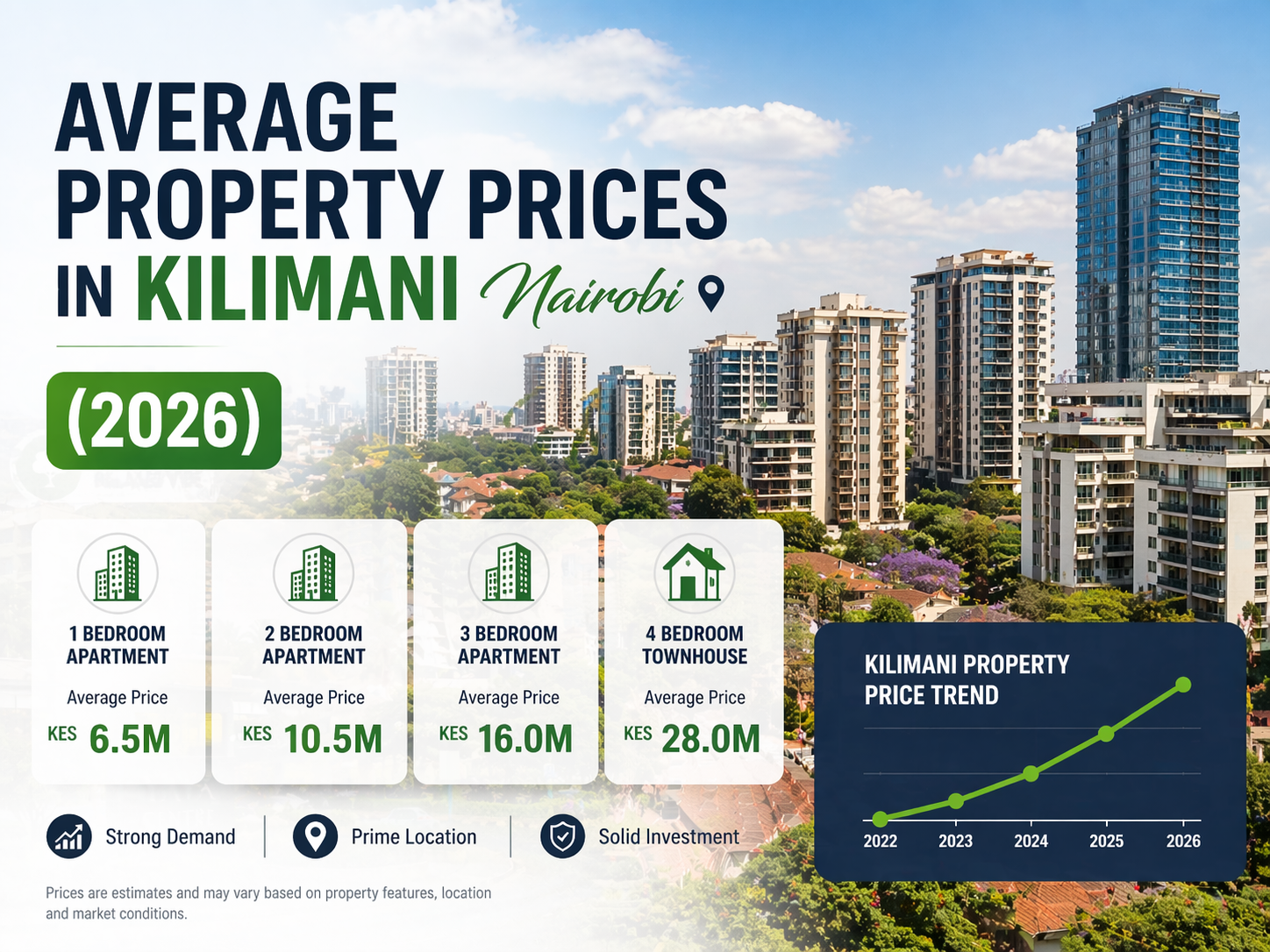
Understanding Property Prices in Kilimani: What the Market Actually Looks Like
Kilimani is one of those neighbourhoods where the asking price and the transaction price can sit surprisingly far apart. Developers and resale vendors often anchor their listings to prices that made sense three or four years ago, while the actual deals being done reflect a market that has corrected significantly from its 2019 peak. For buyers, renters, and investors who want to make informed decisions, the gap between listed prices and real transaction values is the most important thing to understand before you start negotiating.
This guide breaks down current pricing across every property category in Kilimani: apartments for sale, houses for rent, commercial-facing units, and the short-let segment. It also explains what drives price variation within the neighbourhood, because two 2-bedroom apartments priced Ksh 6 million apart can be on the same street and the difference is entirely explainable once you know what to look for.
For the full neighbourhood context, read the Complete Guide to Living in Kilimani Nairobi and the Pros and Cons of Living in Kilimani before making any decisions based on price data alone.
Apartment Sale Prices in Kilimani: Current Ranges
The apartment market in Kilimani is the most active and most liquid property segment in the neighbourhood. Nearly all new development in Kilimani over the last fifteen years has been high-density residential apartments, which means there is a wide range of stock available across different ages, finishes, locations, and building quality levels.
Studio Apartments
Studios in Kilimani typically sell in the range of Ksh 3.5 million to Ksh 5.5 million. The lower end of this range reflects older blocks with basic finishes, limited amenities, and in some cases unreliable building management. The upper end reflects newer developments where studios have been designed with open-plan layouts, good natural light, fitted kitchenettes, and access to shared amenities including pools and gym facilities.
From a market perspective, studios are the most oversupplied unit type in Kilimani and carry the weakest resale demand. Most buyers in this segment are first-time investors rather than owner-occupiers, and competition from an oversaturated rental market makes yield achievement difficult unless the unit is being operated as a short-let. Studios are not recommended as primary investment vehicles in the current Kilimani market unless they can be acquired at significant discount to replacement cost.
One-Bedroom Apartments
One-bedroom apartments in Kilimani range from Ksh 5.8 million on the low end for older stock in basic condition to Ksh 13 million for newer units in well-managed premium blocks with backup power, borehole water, gym access, and quality internal finishes.
The mid-range for a decent 1-bedroom in a reasonably well-managed block sits between Ksh 7.5 million and Ksh 10 million. Units in this price band represent reasonable value for investors targeting the long-let market, provided the block’s management fees are not so high as to erode net yield below 5 percent.
Most buyers overlook the age of the building’s electrical and plumbing systems when evaluating 1-bedroom apartments in Kilimani. Blocks built before 2010 may be priced attractively but carry significant deferred maintenance costs that will eventually fall on unit owners, either through levy calls from the management company or through direct unit repairs. Always request a copy of the last two years of management company accounts before buying in any block older than twelve years.
Two-Bedroom Apartments
The 2-bedroom segment is the heartbeat of the Kilimani apartment market. It is the most searched, most rented, and most transacted unit type in the neighbourhood, and pricing here reflects the broadest range of quality variation.
Entry-level 2-bedroom units in older or poorly managed blocks start from around Ksh 8.5 million. These are typically sold by owners who need liquidity and are willing to discount from original purchase prices. They can represent value for buyers who are prepared to renovate and manage actively, but they require due diligence on building-wide maintenance issues before committing.
Standard 2-bedroom units in mid-range blocks, which is the bulk of the Kilimani apartment stock, sell in the range of Ksh 11 million to Ksh 17 million. This is the most competitive segment of the market. Price within this range is driven primarily by the building’s management quality, backup power and water provision, parking allocation, and proximity to Ngong Road or Argwings Kodhek Road as the relevant commercial axis.
Premium 2-bedroom units in newer, well-specified blocks with swimming pools, controlled access, professional management, and high-quality internal finishes sell from Ksh 17 million to Ksh 24 million. Units at the top of this range tend to be in buildings that have maintained occupancy and management standards consistently since opening, which is a distinguishing factor in a market where building quality has been variable.
Browse currently available 2-bedroom apartments for sale in Nairobi to benchmark specific listings against these ranges.
Three-Bedroom Apartments
Three-bedroom apartments in Kilimani occupy a narrower price band with less volume than the 2-bedroom segment, but they attract a more stable buyer and tenant profile. Families, senior professionals, and corporate tenants are the primary demand drivers, and this demand has proven more resilient than the investor-driven 1-bedroom and 2-bedroom segments during the broader market correction.
Standard 3-bedroom units with a DSQ sell in the range of Ksh 16 million to Ksh 30 million depending on size, finish, and building quality. Larger 3-bedroom configurations above 150 square metres in premium blocks can reach Ksh 35 million to Ksh 45 million. Penthouse and duplex 3-bedroom units are priced individually and can exceed Ksh 55 million in the most well-regarded developments.
From a rental yield perspective, 3-bedrooms in Kilimani tend to deliver lower gross yields than 2-bedrooms but carry lower vacancy rates and longer average tenancy terms. The trade-off between yield and stability is a genuine one, and the right answer depends on the investor’s income requirements versus capital preservation objectives.
See available 3-bedroom apartments for sale in Kilimani and compare with 3-bedroom apartments for sale across Nairobi.
Four-Bedroom Apartments and Penthouses
True 4-bedroom apartment configurations in Kilimani are limited in supply. Most of the high-density developments in the neighbourhood were optimised for smaller unit sizes to maximise the number of units per block, so large 4-bedroom apartments are less common than in Westlands or Lavington.
Where they exist, 4-bedroom apartments in Kilimani sell in the range of Ksh 35 million to Ksh 70 million. Penthouse units with private terraces and premium finishes sit at the upper end or above this range. The buyer profile at this price point is almost exclusively owner-occupiers, and resale liquidity in this segment is lower than for smaller unit types.
Rental Prices in Kilimani: Long-Let and Short-Let
Long-Let Monthly Rents
The long-let rental market in Kilimani has been in correction mode for several years, and current achievable rents reflect that reality. The following ranges apply to unfurnished units on standard 12-month lease terms:
- Studio apartments: Ksh 45,000 to Ksh 60,000 per month. Basic studios in older blocks at the lower end. Newer studios with good finishes and building amenities at the upper end.
- 1-bedroom apartments: Ksh 75,000 to Ksh 80,000 per month. The mid-point for a decent 1-bedroom in a well-managed block is around Ksh 50,000 to Ksh 58,000.
- 2-bedroom apartments: Ksh 80,000 to Ksh 130,000 per month. Standard 2-beds in good blocks typically achieve Ksh 70,000 to Ksh 95,000. The upper end requires premium finishes, reliable backup systems, and strong building management.
- 3-bedroom apartments: Ksh 95,000 to Ksh 200,000 per month. Corporate lets and diplomatic tenants regularly pay the upper end of this range for well-furnished, well-managed units.
These figures exclude service charges, which range from Ksh 5,000 to Ksh 25,000 per month depending on the building. In practice, a tenant budgeting Ksh 85,000 for a 2-bedroom all-in should search for units listed at Ksh 65,000 to Ksh 75,000 to allow for service charges and water costs above the base rent.
Furnished and Serviced Units
Furnished long-let units in Kilimani command a premium of roughly 25 to 40 percent above equivalent unfurnished rents. A well-furnished 2-bedroom unit in a quality block typically achieves Ksh 110,000 to Ksh 160,000 per month on long-let terms, targeting the expat and corporate relocation market.
The key word is “well-furnished.” Properties furnished with low-quality fittings or outdated furniture do not command this premium. The benchmark for the corporate and diplomatic tenant segment is appliances from recognised brands, quality mattresses and linens, functional kitchen equipment, fast and reliable internet infrastructure, and a professional property manager who responds to issues within 24 hours. Meeting all of these conditions reliably is what separates the top-performing furnished lets from the average ones.
Short-Let and Airbnb Returns
The short-let market in Kilimani has matured significantly over the last five years. Kilimani is now one of the top-performing areas in Nairobi on Airbnb and similar platforms, driven by its central location, restaurant scene, and the concentration of business travellers, conference attendees, and project-based workers who pass through the city.
A well-managed, well-reviewed 2-bedroom unit in Kilimani can achieve nightly rates of Ksh 7,000 to Ksh 14,000 depending on season, finishes, and reviews. At an occupancy rate of 70 to 75 percent across the year, which is achievable for a professionally managed listing, this translates to gross monthly income of Ksh 150,000 to Ksh 230,000, substantially above equivalent long-let returns.
The caveat is that short-let income is not passive income. It requires active management or a reliable co-hosting arrangement, ongoing investment in guest experience, and vigilance around maintenance issues that surface faster under short-let turnover than under long-let occupation. Investors who treat short-let as a set-and-forget income stream tend to underperform relative to those who treat it as a hospitality operation.
What Drives Price Variation Within Kilimani
Two apartments with identical bedroom counts and superficially similar descriptions can vary by Ksh 5 million or more in the Kilimani market. Understanding the drivers of that variation is what allows buyers to identify genuine value and avoid overpaying for the wrong unit in the wrong building.
Building Management Quality
This is the single most important factor that most buyers evaluate last, if at all. A well-managed building in Kilimani will have consistent backup power through a generator or solar hybrid system, reliable borehole or tankered water supply that does not fail for days at a time, clean common areas, functioning lifts that are serviced regularly, and a responsive management company that communicates with residents and resolves issues in a reasonable timeframe.
A poorly managed building will have generators that run out of fuel and are not refilled promptly, water supply failures that last three to five days during dry periods, lifts that are out of service for weeks at a time, and a management company that is difficult to contact and slow to act. Living in a poorly managed block in Kilimani is genuinely miserable regardless of how good the unit itself is.
The price premium for a well-managed block over a poorly managed one in the same street is typically Ksh 2 million to Ksh 4 million for a 2-bedroom apartment. It is almost always worth paying.
Floor Level
In Kilimani’s dense streetscape, floor level carries significant pricing weight. Units on the first and second floors face noise from the street and reduced natural light. Units from the fifth floor upward in most blocks begin to clear the surrounding roofline, improving ventilation, light quality, and noise levels substantially. Top-floor units in well-constructed buildings with proper waterproofing command a visible premium in both sale and rental markets.
Parking Allocation
Parking is a genuine constraint in Kilimani, and units with dedicated, covered parking spaces are meaningfully more valuable than units with shared or uncovered parking, or no allocated parking at all. A 2-bedroom unit with two basement parking spaces in a controlled-access building can command Ksh 1.5 million to Ksh 2.5 million more than an equivalent unit with surface parking or a shared arrangement.
Street Orientation and Noise Exposure
Units facing away from major roads in Kilimani are quieter and more comfortable to live in. In practice this means units on the inner courtyards of blocks, or on streets running perpendicular to Ngong Road and Argwings Kodhek Road, offer a meaningfully better residential environment than street-facing units on the main arteries. This is not always reflected in asking prices, which creates occasional opportunities for buyers who understand the distinction and can negotiate accordingly.
Proximity to Amenities
Addresses within 5 to 8 minutes’ walk of Junction Mall, Hurlingham Shopping Centre, or the commercial cluster around Valley Arcade carry a consistent premium over addresses that require a car for basic errands. This is partly a lifestyle premium and partly a rental market premium, because walkable locations are easier to let and achieve slightly higher rents than equivalent units in car-dependent pockets of the neighbourhood.
How Kilimani Prices Compare to Nearby Neighbourhoods
Kilimani sits in a competitive mid-premium position relative to its neighbours. It is generally more affordable than Westlands for equivalent apartment types, comparable with Kileleshwa in the mid-range segment, and significantly more affordable than Lavington for houses.
A 2-bedroom apartment that sells for Ksh 14 million in Kilimani would typically be priced at Ksh 16 million to Ksh 19 million in an equivalent Westlands block, and Ksh 12 million to Ksh 15 million in Kileleshwa depending on the specific building. This relative positioning makes Kilimani a logical choice for buyers who want Westlands-level amenity access at a slightly lower entry price, accepting the trade-off of higher density and less building exclusivity.
For a full comparison of Kilimani and Kileleshwa pricing and lifestyle differences, read Kileleshwa vs Kilimani: Which Area Is Better? For the Westlands comparison, see Westlands vs Kilimani: Which Is Better to Live In?
Price Trends: Where Is the Kilimani Market Heading?
The Kilimani apartment market bottomed out broadly between 2022 and 2024 in the wake of the off-plan oversupply correction and a period of elevated construction financing costs. The most distressed segment, studios and 1-bedroom apartments in average-quality blocks, has not yet seen recovery and may take several more years to fully absorb the excess supply.
The 2-bedroom and 3-bedroom segments in quality buildings are showing early signs of stabilisation. Void periods are shortening in well-managed blocks, and some landlords who were offering concessions two years ago have stopped doing so as demand in the upper-mid segment firms up. This does not mean prices are rising quickly, but the floor appears to be established in the better-quality sub-market.
The variables to watch are the trajectory of commercial mortgage rates, which directly affect the purchasing power of the salaried middle-class buyer who drives demand in the Ksh 10 million to Ksh 18 million range, and the pace of new supply completions. If the pipeline of new developments that began construction in 2022 and 2023 delivers as scheduled, the supply pressure will remain elevated through 2026. If construction timelines slip, as they frequently do in Nairobi’s market, the demand-supply balance may improve faster than current projections suggest.
For investors considering entry now, the combination of below-replacement-cost pricing in some segments and genuine short-let income potential makes the current period more interesting than the peak years. The key discipline is buying selectively rather than opportunistically, prioritising building quality and management over price alone.
Practical Guidance for Buyers and Renters
For renters, the current market strongly favours negotiation. Use the rent ranges in this guide as your baseline and approach any landlord whose asking price sits above the upper end of the relevant range with a well-evidenced counter-offer. Provide evidence of stable employment, good references from previous landlords, and offer to pay three to six months upfront in exchange for a meaningful reduction on the monthly rate. Many Kilimani landlords will accept this trade.
For buyers, prioritise management quality and building condition over unit finish. A well-managed building with dated unit interiors is a much better investment than a beautifully finished unit in a poorly run block. Interiors can be upgraded at controlled cost. Building management culture is very difficult to change once it has deteriorated.
Always request the service charge schedule, the building’s maintenance history, and the management company’s contact details before making an offer. These documents tell you far more about the true cost and quality of ownership than any agent’s marketing description.
When you are ready to look at specific options, browse apartments for sale in Kilimani and affordable apartments for sale in Nairobi for a wider comparison set. If you are evaluating Kilimani as an investment rather than a residence, the dedicated investment analysis for Kilimani covers yield calculations, exit strategy, and the specific building characteristics that separate high-performing assets from underperforming ones.
Return to the full Kilimani Neighbourhood Guide for an index of all cluster articles, or go back to the Nairobi Neighbourhood Guide to compare Kilimani’s pricing position against the full spectrum of the city’s residential market.

Join The Discussion