

What Kind of Neighbourhood Is Kilimani, Really?
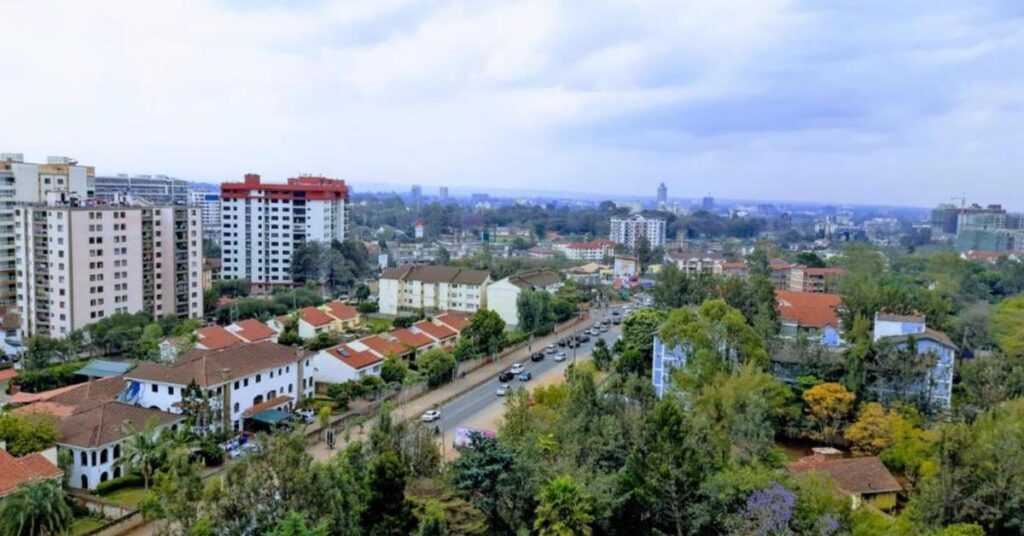
Kilimani sits roughly two kilometres south-west of Nairobi’s central business district, bounded by Ngong Road to the south, Argwings Kodhek Road to the east, Valley Road to the north-east, and the residential fringe of Lavington to the west. On a map it looks compact. On the ground, it feels like four different neighbourhoods sharing one postcode.
The stretch along Lenana Road buzzes from early morning until well past midnight. Restaurants, clinics, salons, and co-working spaces fill the ground floors of mid-rise apartment blocks, and the pavements are busy enough that you notice them. Riara Road is calmer, more residential, and the apartment developments there tend to attract longer-term tenants rather than Airbnb guests. The streets around Argwings Kodhek Road near the Hurlingham end feel almost village-like compared to the density along Denis Pritt Road, where some of the city’s most aggressive high-rise development has happened over the last decade.
Understanding these micro-zones within Kilimani matters, especially if you are buying to invest. The right street can make a meaningful difference to both your rental income and your resale timeline. This guide covers all of it.
Back to the Nairobi Neighbourhood Guide for a full overview of how Kilimani compares to other areas across the city.
Who Lives in Kilimani?
Kilimani has one of the most mixed resident profiles of any neighbourhood in Nairobi, and that diversity is part of what makes it function so well as a rental market.
Young Kenyan professionals in their late twenties and thirties make up the largest group. These are typically dual-income households, often childless or with one young child, who value proximity to Upper Hill, the CBD, Westlands, and the hospital corridor along Argwings Kodhek Road. They are generally renting rather than owning, and they will pay above-average rent for good finishes, reliable water supply, and a generator that actually works.
NGO and embassy staff form the second major tenant group. Nairobi hosts one of Africa’s largest concentrations of international organisations, and Kilimani sits within reasonable commuting distance of the United Nations complex in Gigiri, the European Union offices in Upper Hill, and numerous bilateral missions. These tenants tend to stay for one to three years, pay on time, and cause minimal wear on a property. Landlords who understand this profile tend to price and furnish their units accordingly.
Short-let and Airbnb operators represent a growing segment. Kilimani’s central location, walkability, and restaurant density make it highly competitive on short-let platforms. Developers have noticed. Several newer blocks have been purpose-designed for serviced apartment operation, with smaller unit configurations, hotel-style lobbies, and in-house management. This has created a two-tier rental market within the same postcode.
Families with school-age children are present but less dominant than in Lavington or Karen. The density and noise levels in the busier parts of Kilimani make it a harder sell for households with multiple children, though quieter pockets near Riara Road and the lower ends of Galana Road do attract family tenants.
Rent Prices in Kilimani: What to Expect in 2025
Kilimani’s rental market has gone through a genuine correction since the peak of 2018 to 2020. Oversupply in the studio and one-bedroom segment has pushed asking rents down, and many landlords who bought off-plan during that period are now offering concessions to maintain occupancy. The two-bedroom and three-bedroom segments have held up better because demand from professionals and small families remains consistent.
In practice, here is what the market looks like for unfurnished long-let units in standard apartment blocks:
- Studio apartments: Ksh 25,000 to Ksh 45,000 per month. The low end of this range is genuine; oversupply in this segment means tenants have real negotiating power.
- 1-bedroom apartments: Ksh 40,000 to Ksh 75,000 per month. Quality of finishes and the building’s management reputation drive significant variation within this range.
- 2-bedroom apartments: Ksh 60,000 to Ksh 130,000 per month. Well-maintained blocks with backup power and water tanks command the higher end. Basic blocks without these features struggle to achieve Ksh 80,000 even in good locations.
- 3-bedroom apartments: Ksh 100,000 to Ksh 200,000 per month. Large 3-beds in premium blocks with en-suite finishes, fitted kitchens, and generous parking can exceed this range.
For furnished and serviced units targeted at expatriates or short-let guests, rates are considerably higher. A well-managed furnished 2-bedroom in a quality block typically fetches Ksh 120,000 to Ksh 180,000 monthly on long-let terms, and can generate equivalent or higher returns on a short-let basis during high-occupancy periods.
One factor most renters overlook: service charges. Kilimani’s apartment blocks carry service charge structures ranging from Ksh 5,000 to Ksh 25,000 per month depending on the building’s amenities. Always clarify whether the quoted rent is inclusive or exclusive of service charges before signing a lease.
Property Prices in Kilimani: Buying in 2025
The for-sale market in Kilimani reflects the same correction visible in rents. Off-plan prices from 2017 to 2020 were based on rental projections that did not fully materialise, which means some developers and early buyers are now selling at or below original purchase prices when you account for inflation. This creates genuine opportunity for buyers entering now.
Current transaction prices for completed units in Kilimani:
- 1-bedroom apartments: Ksh 5.5M to Ksh 12M. Older blocks on less desirable streets sit at the lower end. Newer developments with modern finishes and amenities approach the upper range.
- 2-bedroom apartments: Ksh 9M to Ksh 22M. This is the most liquid segment. Units priced between Ksh 12M and Ksh 16M in well-managed blocks tend to sell or rent faster than any other configuration in Kilimani.
- 3-bedroom apartments: Ksh 18M to Ksh 40M. Larger 3-beds with DSQ (domestic staff quarter) attract families and executives and tend to hold value better than smaller units in the same block.
- Penthouses and duplex units: Ksh 35M to Ksh 80M. A niche but genuine market. Buyers here tend to be owner-occupiers rather than investors.
You can browse currently available 3-bedroom apartments for sale in Kilimani on the listings page. For a broader search across Nairobi, see 2-bedroom apartments for sale in Nairobi and affordable apartments for sale in Nairobi.
Traffic and Getting Around: The Honest Picture
Traffic is the single most important quality-of-life factor in Kilimani, and it deserves more than the vague assurance that the area is “centrally located.” Central location means nothing if a 3-kilometre commute regularly takes 45 minutes.
The main pressure points are well established. Ngong Road inbound carries heavy congestion from the Prestige Plaza junction all the way to the Haile Selassie Avenue intersection between 7:00 AM and 9:30 AM on weekdays. Argwings Kodhek Road backs up significantly between the Hurlingham roundabout and Upper Hill from 7:30 AM onwards. Denis Pritt Road, which many residents use as a cut-through to Valley Road, gets blocked early by construction deliveries to the numerous developments still active along its length.
The evening picture is worse. Southbound Ngong Road from the junction at Bishop Road can be near-stationary from 4:30 PM to 7:00 PM. Residents who commute by car to Upper Hill or the CBD regularly report that the actual drive is under 3 kilometres but takes 30 to 50 minutes during peak hours.
In practice, Kilimani residents who manage their commutes best tend to do one of three things. They walk or cycle to nearby destinations, which is genuinely viable given the neighbourhood’s compactness and amenity density. They time their journeys outside peak hours, which suits the significant portion of residents who work for themselves, in creative industries, or for organisations with flexible hours. Or they use boda bodas for last-mile movement, which is faster than any car journey within the 2 to 5 kilometre radius during peak time.
For a deeper analysis of transport options and road access across Nairobi’s key neighbourhoods, see Transport and Accessibility in Kilimani or the broader Nairobi Neighbourhood Guide.
Schools Near Kilimani
Kilimani is not naturally a school-driven neighbourhood in the way that Karen or Lavington are, but families living here have access to several credible options within a short distance.
Within or immediately adjacent to Kilimani, Nairobi Arboretum Forest School on State House Road offers an internationally-oriented primary programme and is popular with the NGO community. Hillcrest Secondary School on Old Muthaiga Road is a short drive away and serves the upper secondary market. Strathmore School, one of Nairobi’s best-regarded private schools, is on Lavington’s side of the Ngong Road corridor but accessible from Kilimani without crossing the worst traffic nodes.
For families requiring international curriculum, the range widens considerably when you extend the radius to 15 minutes in non-peak traffic. Braeburn Garden Estate, the International School of Kenya in Lavington, and Rosslyn Academy in Gigiri are all reachable, though the daily commute for young children in morning traffic deserves careful consideration before committing.
Read the dedicated Schools Near Kilimani for Families guide for a full breakdown of options, catchment details, and fee ranges.
Shopping, Restaurants, and Daily Life
This is where Kilimani genuinely earns its premium. The density of useful amenities within walking distance of most residential addresses is unmatched by any other neighbourhood in Nairobi outside Westlands.
Junction Mall on Ngong Road handles bulk shopping through Carrefour, which replaced the old Nakumatt and has become the main anchor for the neighbourhood’s grocery needs. Adams Arcade, a smaller centre at the junction of Ngong Road and Elgeyo Marakwet Road, provides a solid cluster of specialist retailers, food outlets, and service businesses. Hurlingham Shopping Centre serves the eastern fringe and has strong pharmacy, hardware, and fast food provision.
The restaurant scene along Lenana Road and the side streets off Denis Pritt Road has developed considerably. You will find credible Ethiopian, Italian, Lebanese, Indian, and Japanese options within a ten-minute walk of most Kilimani addresses. Nairobi Java House has multiple branches in the area. Small café culture has taken hold, and the kind of specialty coffee that would once have required a trip to Westlands is now available on several Kilimani streets.
Healthcare provision is notably strong. The Nairobi Hospital on Argwings Kodhek Road is one of Kenya’s flagship private hospitals. Aga Khan Hospital is accessible in under fifteen minutes. Kenyatta National Hospital, the country’s main referral facility, is on Hospital Road near Upper Hill. For routine health needs, Kilimani has enough clinics, dental practices, and pharmacies that most residents never need to travel far.
See the full Shopping Centres and Amenities in Kilimani guide and Lifestyle and Entertainment in Kilimani for more detail.
Safety and Security in Kilimani
Kilimani has a reasonably good security reputation relative to the city as a whole, but it is not uniform across all streets and times of day. The established apartment complexes with perimeter walls, controlled access, and on-site guards are the safest living option. Standalone houses and older, less-managed blocks in quieter streets carry higher risk, particularly at night.
Street crime, specifically phone snatching and bag theft near busy commercial strips, is a real and recurring issue. The stretches around Junction Mall, along Ngong Road near Valley Arcade, and in some sections of Lenana Road at night have seen incidents. This does not make Kilimani dangerous in any absolute sense, but it makes situational awareness a practical necessity rather than a precaution.
The private security market in Kilimani is well developed. Most mid-to-upper-range apartment blocks contract with established security firms, and some of the premium developments have implemented CCTV systems, biometric access, and panic-button response contracts. Buyers and renters who prioritise security should ask specific questions about the building’s security infrastructure rather than accepting general assurances.
Read the dedicated Safety and Security in Kilimani guide for a neighbourhood-by-neighbourhood breakdown.
Investment Potential: Is Kilimani Worth Buying In?
The answer depends entirely on what you are buying, at what price, and with what strategy in mind.
Kilimani is not a capital appreciation play in the traditional sense. The high volume of new supply has kept price growth flat in the apartment segment for several years. Buyers who purchased at 2019 peak prices have not seen meaningful nominal appreciation, and once you account for inflation, many have seen real-terms losses on their entry price.
Where Kilimani does work for investors is on yield, specifically for operators who understand the short-let market. A well-managed, well-furnished 2-bedroom unit in a block with reliable backup services can generate gross yields of 8 to 10 percent when operated as a short-let property through platforms like Airbnb or through corporate housing companies serving the NGO community. This is significantly above the 5 to 6 percent you would typically achieve on a long-let basis.
The other scenario that works is buying a genuinely distressed unit at a below-market price. Because of the correction in the off-plan segment, there are genuine motivated sellers in Kilimani right now. Buyers who can identify these opportunities, complete quickly, and enter at a price that reflects current rental reality rather than 2019 projections can build a reasonable income-generating portfolio.
What does not work in Kilimani right now is buying a standard mid-range apartment at full asking price with the expectation that rents will rise quickly enough to justify the entry cost. The fundamentals do not support that thesis in the near term.
Read the full analysis at Is Kilimani a Good Place for Property Investment? and compare with the investment case for Kileleshwa and Westlands.
Kilimani Versus Other Nairobi Neighbourhoods
Buyers frequently compare Kilimani against its nearest neighbours before making a decision. Here are the honest distinctions worth understanding.
Kilimani vs Kileleshwa: Kileleshwa is quieter and feels more purely residential. Kilimani has more amenities within walking distance but more noise and density. Rental yields in both areas are comparable, but Kileleshwa tends to attract longer tenancies from more established professionals. See the full Kileleshwa vs Kilimani comparison.
Kilimani vs Westlands: Westlands has stronger commercial infrastructure and a more cosmopolitan nightlife and restaurant scene. Kilimani is more residential in character and generally easier to navigate on foot during the day. Property prices in Westlands tend to be higher. See Westlands vs Kilimani: Which Is Better to Live In?
Kilimani vs Lavington: Lavington is lower-density, greener, and better suited to families with children. Kilimani is denser, more urban, and better suited to professionals who value walkability and convenience over space. Lavington property prices are generally higher on a per-unit basis for houses. See Lavington vs Kileleshwa for a related comparison.
Key Facts for Buyers and Renters
- Best unit type for investment: 2-bedroom apartments in mid-to-upper-range blocks with backup power, water tanks, and secure parking.
- Best streets for quiet living: Riara Road, lower Galana Road, parts of Elgeyo Marakwet Road away from the commercial junction.
- Avoid if: You need a large outdoor space, have multiple school-age children who need a garden, or are sensitive to traffic noise and construction activity.
- Consider if: You prioritise walkability, want access to strong amenities without a car, work in Upper Hill or the CBD, or are operating a serviced apartment investment.
- Lease terms: Most landlords in Kilimani work on 12-month leases with one to two months deposit. Some premium blocks require 3 months deposit and will negotiate on rent for prepayment of 6 or 12 months upfront.
- Service charge clarity: Always request a copy of the management company’s service charge schedule before signing. Charges vary widely and are not always disclosed upfront.
Next Steps
If Kilimani fits your lifestyle and budget requirements, the next step is identifying the right block and the right unit type for your specific situation. The neighbourhood is large enough and varied enough that a general interest in Kilimani is just the starting point.
Browse currently available apartments for sale in Kilimani, explore the pros and cons of living in Kilimani in more detail, or read about the best apartment complexes in Kilimani to understand which buildings consistently attract quality tenants and maintain values.
For a full picture of how Kilimani fits within the wider city, return to the Nairobi Neighbourhood Guide. To compare Kilimani directly against the rest of the inner premium belt, see the guides for Kileleshwa, Westlands, and Lavington.

Join The Discussion